Beyond the Front Desk: How Secure Patient Chat Is Changing Perth Dental Clinics
Local Health Care
Editorial
If you walked into a busy Perth dental clinic at 9:15 on a Monday morning, you'd see roughly the same scene playing out everywhere from Joondalup to Hocking: two receptionists, three phones ringing, four patients standing at the counter holding paperwork, and a queue of voicemails from the weekend that nobody has time to clear yet. Half the calls are reschedules. A quarter are patients ringing to "think about" the treatment plan they were quoted last week. The rest are payment plan questions, post-procedure worries, and CDBS queries that don't really need a clinical answer.
None of this is anyone's fault. It's just the cost of running a dental practice in 2026 with a communication system that hasn't really changed since 1996.
Secure patient chat is changing that. This article explains what it is, what it isn't, and how Perth dental clinics are using it to free up reception, improve patient satisfaction, increase treatment plan acceptance, and stay completely compliant with Australian privacy law.
What secure patient chat actually is (and what it isn't)
It is:
A direct, asynchronous messaging channel between a patient and a specific dental clinic
Built into the clinic's existing booking and patient management workflow
End-to-end encrypted, so even the platform provider can't read message contents
Two-way: patients can message the clinic, and authorised clinic staff can message back
Capable of handling file attachments, including x-rays, treatment plans, consent forms, and photos of a chipped tooth
It isn't:
A 24/7 dental advice line, as patients shouldn't be diagnosing themselves over chat
A replacement for in-chair consults or examinations
A consumer messaging app like WhatsApp, which is not built for healthcare and not appropriate for patient information under Australian privacy law
A free-for-all, as clinic staff control which patients can chat and when
The simplest way to think about it: it's the digital equivalent of the front-desk conversation, but freed from the constraints of a phone line and the working hours of a single human.
Why phone calls are eating your dental reception alive
The economics of phone-based dental reception are brutal. Most clinic phone calls are short (under 90 seconds) but they consume the full attention of a staff member for several minutes when you account for switching context, looking things up, and updating records. Now multiply that by 60-120 calls a day in a multi-chair practice.
The hidden costs:
Patients abandon calls when on hold for more than 60 seconds, then call back later (or, worse, no-show)
Reception burnout is one of the biggest staff turnover issues in Australian dental practices
Phone tag wastes hours when reception calls a patient back during the patient's work hours and gets voicemail
Treatment plans go cold when patients can't easily ask follow-up questions and just stop responding
Information gets lost when verbal messages between reception and clinical staff don't get logged
You can't audit a phone call the way you can audit a written exchange
None of these are solved by hiring more reception staff. They're structural problems with synchronous communication. Asynchronous chat solves them at the root.
What chat is actually used for in Perth dental clinics today
The dental clinics already running secure chat have found a fairly consistent pattern of use cases. The most common, in rough order of frequency:
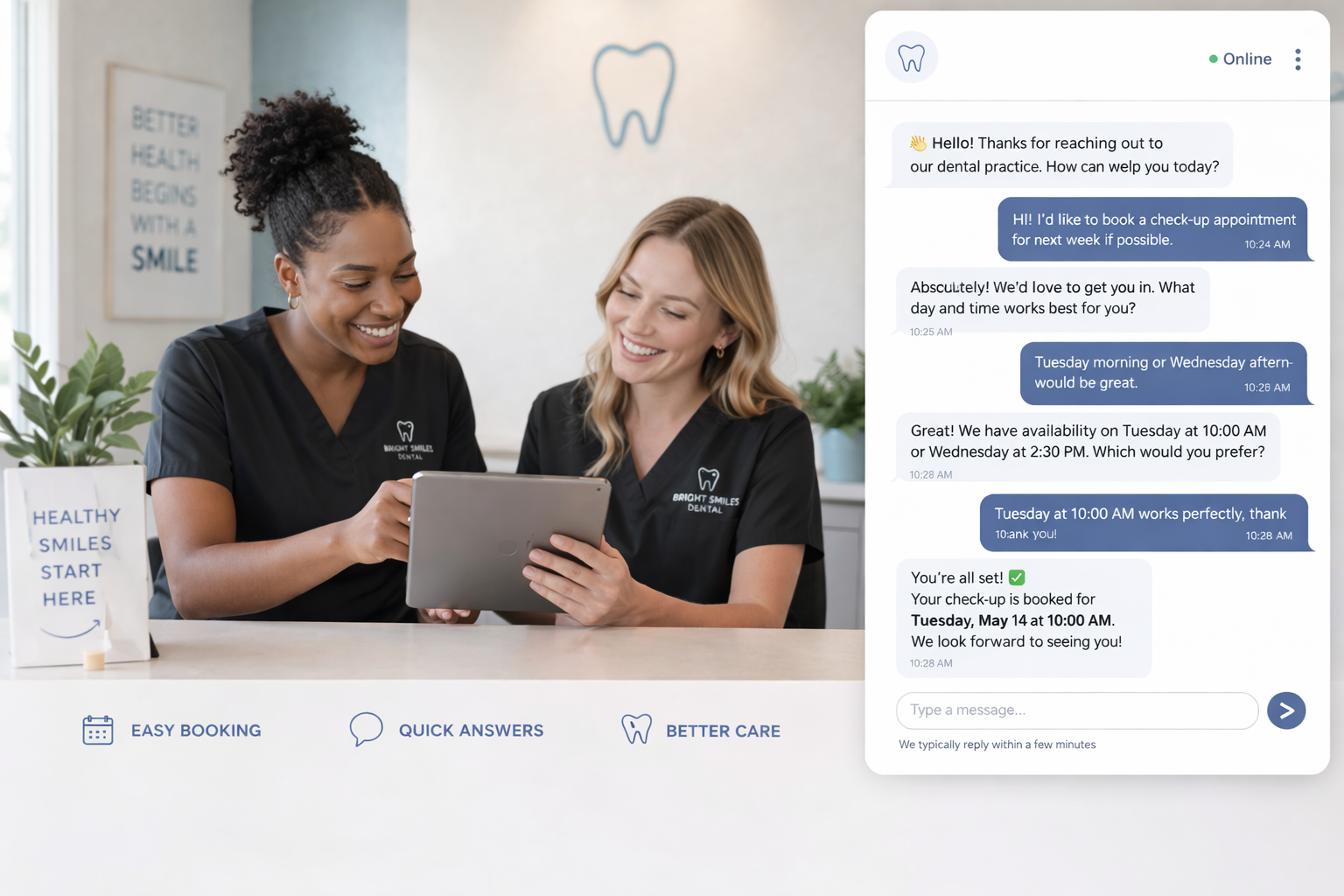
Rescheduling. "Hi, I need to move my Thursday 2pm clean to next week. What do you have?" Reception replies with two slot options and the patient picks one. Total time: 90 seconds across both sides, no phone needed.
Treatment plan questions. "Just looking at the quote for the crown. Can you explain why item 615 is included? And does my fund cover any of it?" The kind of question that, asked in chat, gets answered. Asked over the phone, it often gets avoided entirely.
Payment plan queries. "Do you offer Afterpay for the ortho treatment?" "Can I split the bridge into three payments?" Easy answers that don't need a clinician.
Pre-appointment admin. "Should I bring my old x-rays?" "Do I need to take antibiotics before the extraction?" "Is there parking out the back?"
Post-procedure check-ins. "It's been two days since the filling and it still feels weird when I bite down. Should I be worried?" Quick clinical triage that often resolves the patient's anxiety in one message and avoids an unnecessary follow-up appointment.
CDBS and health fund queries. "How much of my child's CDBS is left?" "Will my fund cover the hygienist visit?"
Sharing documents securely. Patients can attach a photo of a chipped tooth, an old set of x-rays from another clinic, or their health fund card without having to come in or fax anything.
In a typical dental practice, between 30% and 50% of routine phone calls fit into one of these categories. Moving them to chat doesn't just save time. It changes the texture of the day.
The treatment plan acceptance angle (the one nobody talks about)
Here's the part most dental practices miss. Treatment plan acceptance is one of the most important metrics in any dental practice, and it correlates directly with how easy it is for patients to ask follow-up questions.
The typical journey: a patient comes in for a check-up, the dentist identifies a crown or a bridge, the receptionist hands them a written quote, and the patient says "I'll think about it." Then they leave, and most of them never come back. Why? Because thinking about it usually involves a question they didn't ask in the chair, no easy way to ask it later, and a slow drift toward inaction.
Chat changes that journey. The patient who would have ghosted instead messages 48 hours later: "Sorry, can I ask one more thing about the crown. Is the cheaper option still available, or only the one we discussed?" That message gets answered the same day. The treatment proceeds. A practice that systematically follows up cold quotes via chat can lift their treatment acceptance rate noticeably over a quarter.
The privacy and compliance question (the only one that matters)
Australian patient information is protected by the Privacy Act and the Australian Privacy Principles. Any chat system used by a dental clinic has to meet a high bar:
End-to-end encryption. Messages should be encrypted on the patient's device, transmitted encrypted, and stored encrypted. Even the platform provider should not be able to read message contents.
Australian-hosted infrastructure. Data should be stored in Australia under Australian privacy law, not routed through overseas servers.
Granular staff permissions. Not every staff member should be able to see every conversation. Reception, dental assistants, hygienists, and dentists should each have appropriate access.
Auditable history. Every message should be timestamped, attributable to a specific user, and retrievable for compliance purposes.
Patient consent. Patients should opt in to chat. It shouldn't be forced.
Multi-factor authentication. Both clinic staff and patients should have MFA available.
Local Health Care meets all six. Importantly, this is also the reason consumer messaging apps like WhatsApp, iMessage, or Facebook Messenger are not appropriate for dental communication, regardless of how convenient they feel. They're not designed for the healthcare compliance bar and using them for patient communication exposes the practice to real legal risk.
Setting expectations: the policy that makes chat work
Chat falls apart when patients expect 24/7 instant responses. The clinics that get the most out of it are the ones that set expectations clearly and stick to them. A simple, friendly auto-response sent on the first message of any new conversation does most of the work:
Thanks for messaging [Clinic Name]. We respond to messages between 9am and 5pm weekdays, usually within 2 hours during business hours. If your message is urgent or you're in pain, please call us on [phone number]. If this is a dental emergency outside our hours, please call 13 SICK or your nearest emergency department.
That's it. You've protected patient safety, set clear response time expectations, and given them a fallback for emergencies. The vast majority of patients will work within those guardrails happily.
What dental clinic staff need to know about running chat well
Don't try to clinically diagnose anyone over chat. If a patient describes pain or symptoms that need an exam, the right response is to book them in, same day if needed.
Use templated replies for common questions. CDBS eligibility, health fund claiming, payment plans, post-extraction care. Most platforms support saved responses.
Assign chat to a specific person or rotation. Don't leave it as everyone's job, because then it becomes nobody's job.
Use chat to revive cold treatment plans. A polite "just checking in. Any questions about the quote we sent through?" message a week later wins back more treatment than any other follow-up tactic.
Close conversations cleanly. A short "Anything else I can help with?" lets patients confirm they're done and lets you move on.
Track chat volume monthly. If chat is reducing your phone calls, your metrics should show it.
The patient side: why they actually prefer it
Patients consistently rate dental clinics that offer chat higher than those that don't, for the same reason they rate online booking higher than phone booking: it works on their schedule, not the clinic's. A young parent can message at 10pm after the kids are in bed. A shift worker can message between calls. A dentally anxious patient (a much larger group than reception teams realise) can finally communicate without the dread of a phone call to a place they associate with discomfort.
And the chat history acts as a written record patients can refer back to. No more "I'm pretty sure they said the crown was $1,200." It's right there in the thread, with every line of the quote.
Getting started in your clinic
Talk to your existing booking platform about whether they offer secure patient chat. Local Health Care has it built in for participating dental clinics.
Decide who owns chat in your team, whether that's one person, a rotation, or your reception lead.
Draft your first auto-response message using the template above.
Soft-launch to a small group of patients first. Long-standing regulars and patients with active treatment plans are a great place to start.
Track phone call volume and treatment plan acceptance for the next quarter and watch what happens.
Most dental practices that turn chat on never turn it off. Learn more about how Local Health Care's clinic portal works or request a walkthrough to see secure patient chat live.